Blog
Electrical Energy Consumption Meter Guide with Smart Accurate Features
Discover Liuyi Electric’s precise electrical energy consumption meters with advanced accuracy, smart monitoring, and reliable industrial-grade performance.
Read More
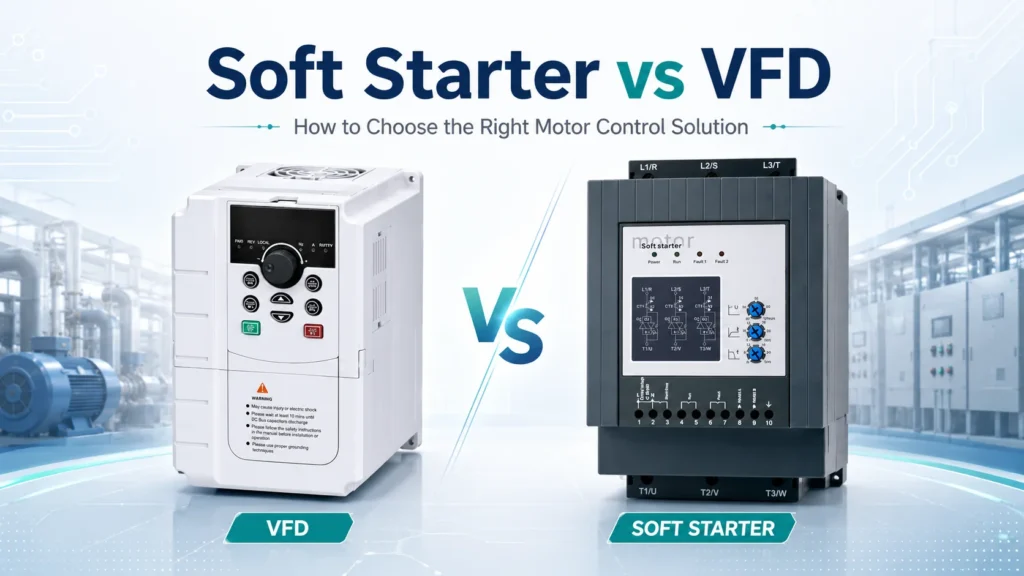
Industrial motor control is not only about getting a motor to start. The right control method can reduce electrical stress, protect mechanical components, improve process stability, and avoid paying for functionality your application never uses.
The most common decision is soft starter vs VFD.
Both devices can reduce the high inrush current associated with direct-on-line starting. However, they solve different problems. A soft starter is designed mainly to make startup and stopping smoother. A variable frequency drive, or VFD, controls the motor throughout its operating cycle by adjusting output frequency and voltage.
For panel builders, OEM machine manufacturers, distributors, and industrial buyers, the correct choice depends on one question:
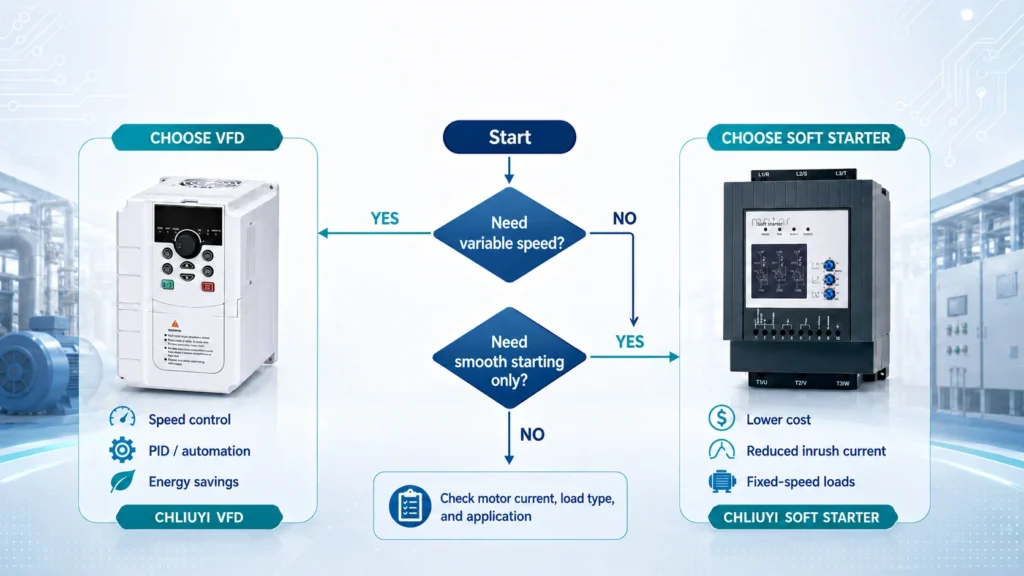
Does the motor need to run at different speeds after startup?
If the answer is no, a soft starter may be the most practical and economical solution. If the answer is yes, a VFD is usually the correct choice.
Choose a soft starter when:
Choose a VFD when:
A soft starter is an electronic motor starting device that gradually increases the voltage supplied to an AC motor during startup.
Instead of applying full line voltage immediately, the soft starter ramps voltage over a defined period. This limits starting current and reduces sudden torque shock on the motor, gearbox, belts, couplings, pipes, and driven equipment.
A soft starter typically uses SCR or thyristor technology to manage the motor’s startup process. Once the motor reaches normal operating speed, many soft starter systems use a bypass contactor or built-in bypass relay so the motor can run directly from the supply.
The key limitation is simple: a soft starter does not provide continuous speed control. After startup, the motor normally operates at its rated supply frequency and full running speed.
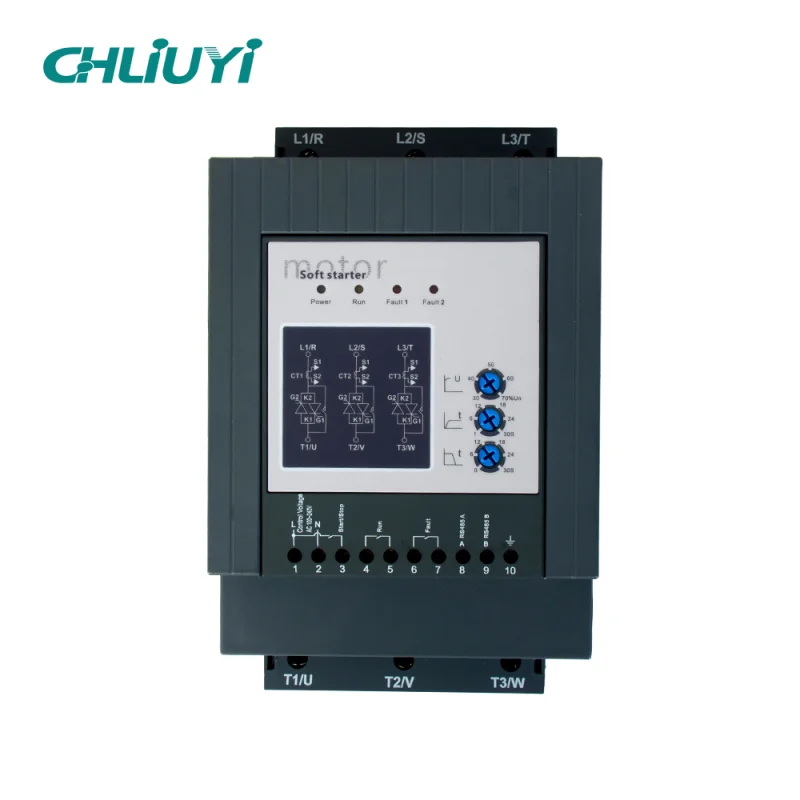
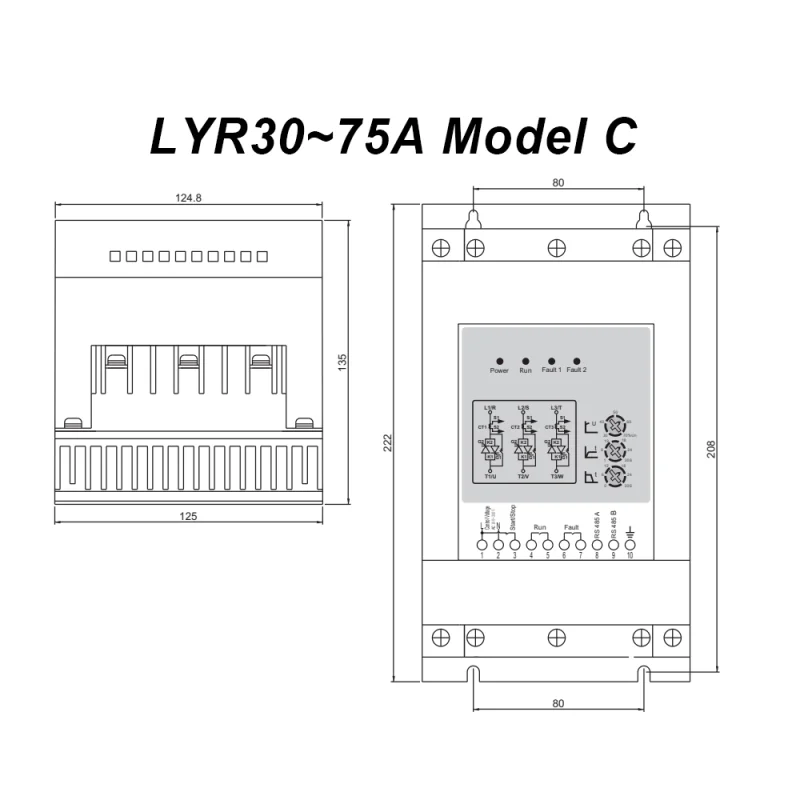
Soft starters are a strong choice for fixed-speed equipment where startup stress is the main concern:
For these applications, a soft starter can reduce startup shock without adding the complexity of a full variable-speed control system.
A variable frequency drive, commonly called a VFD, controls motor speed by changing the frequency and voltage supplied to the motor.
A standard AC induction motor runs at a speed related to the supply frequency. When a VFD lowers the output frequency, the motor slows down. When it increases the frequency within the motor’s allowable range, the motor speed increases.
Unlike a soft starter, a VFD controls the complete motor operating cycle:
This makes a VFD suitable for applications where motor speed must match changing process demand.
VFDs are generally preferred for:
A VFD is not simply a more expensive soft starter. It is a different motor control solution with a wider operating function.
| Comparison Item | Soft Starter | VFD |
|---|---|---|
| Main purpose | Reduce starting current and mechanical shock | Control motor speed and torque throughout operation |
| Motor speed control | No continuous speed control | Full variable-speed control |
| Starting current | Reduced through voltage ramping | Controlled through frequency and voltage adjustment |
| Running speed | Normally fixed at full line frequency | Adjustable during operation |
| Energy-saving potential | Limited during steady running | High potential in variable-load applications |
| Panel complexity | Simpler | More complex |
| Initial cost | Usually lower | Usually higher |
| Installation space | Typically smaller | Typically larger |
| Process control | Basic start and stop control | Advanced control, PID, automation compatibility |
| Suitable load type | Fixed-speed loads | Variable-speed or process-controlled loads |
| Harmonics and EMC | Lower system complexity | Requires attention to harmonics, cable length, and EMC design |
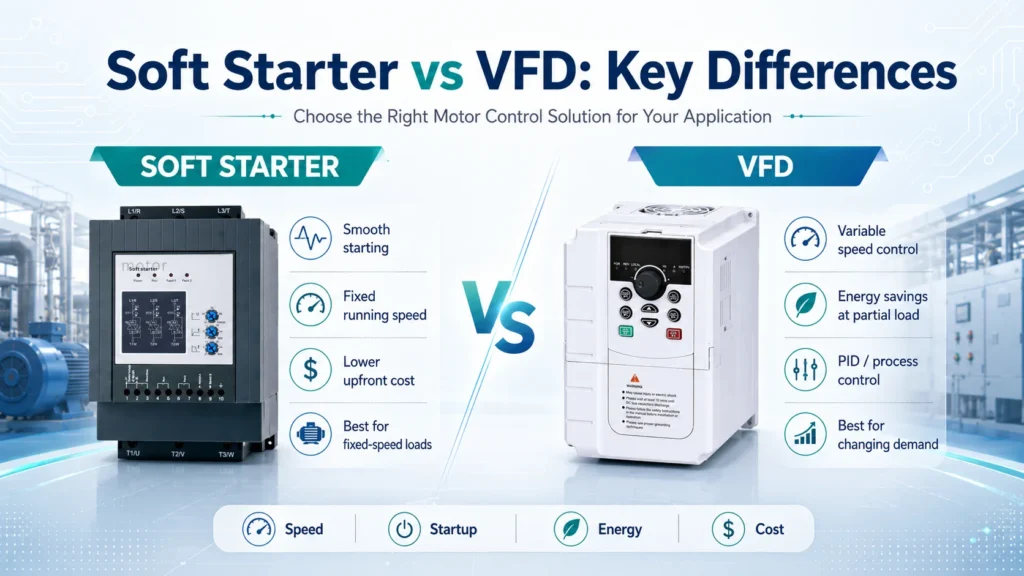
The biggest difference between a soft starter and a VFD is what happens after the motor reaches operating speed.
A soft starter helps the motor reach full speed smoothly. Once the ramp-up period is complete, the motor typically runs at full speed.
A VFD continues controlling the motor after startup. It can maintain a lower speed, increase speed when demand rises, reduce speed during low demand, and manage controlled stopping.
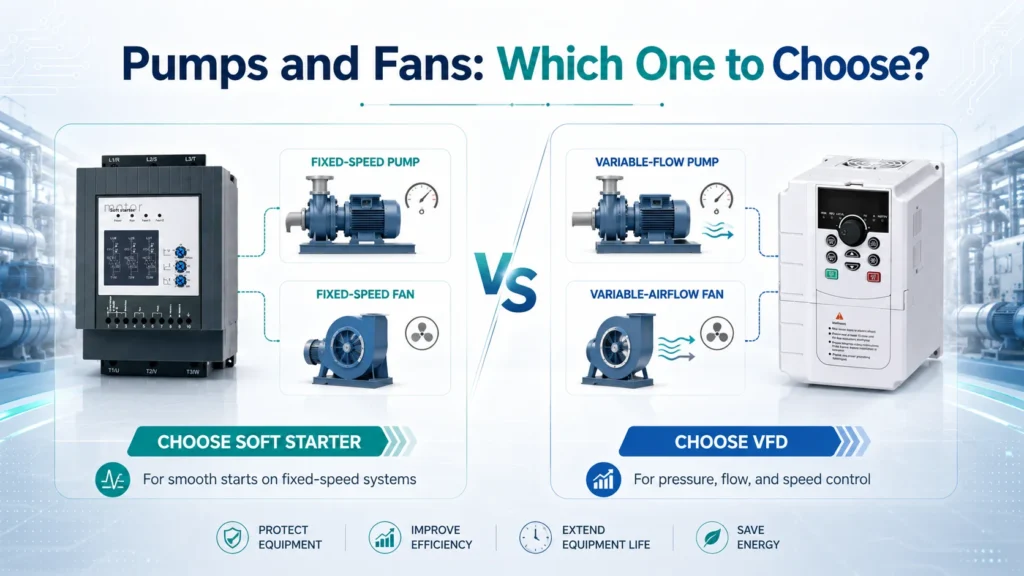
This matters especially for pumps and fans.
For example, a pump that always runs at full speed may only need a soft starter to reduce water hammer and starting current. But a pump that must maintain changing water pressure needs a VFD with pressure feedback and PID control.
Pumps are one of the most common applications for both devices, but the correct solution depends on system demand.
A soft starter can help reduce sudden acceleration and lower the risk of water hammer during pump startup and stopping.
A VFD can match pump speed to demand instead of using throttling valves or running at full speed continuously.
Fans are another important application where the choice depends on airflow demand.
A soft starter works well when the fan always runs at one speed and only needs a smoother startup.
A VFD is better when airflow must change with occupancy, temperature, production conditions, or ventilation requirements. In HVAC and industrial ventilation systems, speed control can improve process stability and reduce unnecessary energy consumption.
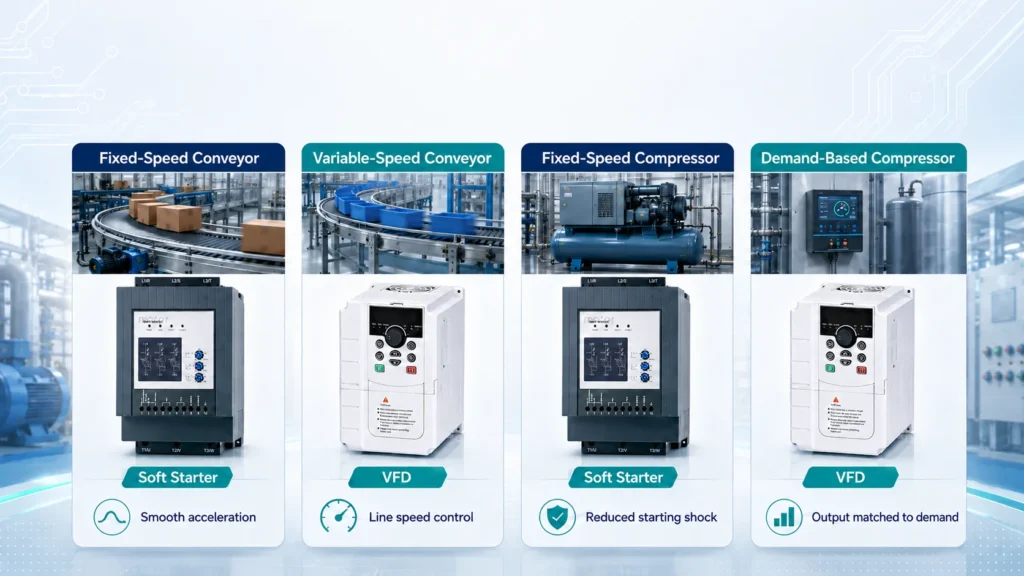
Conveyors often need smooth acceleration, especially when transporting fragile materials or starting under load.
A soft starter is usually enough when the conveyor runs at one fixed speed. It helps reduce belt slip, mechanical shock, and sudden load transfer.
A VFD becomes the better choice when the conveyor speed must match upstream or downstream equipment, when production rates change, or when the system requires synchronized line control.
For a fixed-speed compressor that only needs lower starting current and smoother motor acceleration, a soft starter can be a cost-effective solution.
For compressors that must adjust output to match variable air demand, a VFD is often more suitable. However, compressor applications should always be checked against the compressor manufacturer’s allowable speed range, lubrication requirements, cooling performance, and minimum operating speed.
A soft starter normally has a lower initial purchase cost and a simpler control architecture. It is often the better investment when the motor will run at full speed after startup for most of its operating life.
A VFD requires more initial investment because it includes power conversion, speed control, programming, protection functions, and often additional EMC or harmonic considerations.
However, the lower upfront cost of a soft starter does not automatically make it the lower-cost option over the life of the system.
When a fan or pump spends many hours operating below full load, a VFD can reduce wasted energy by reducing motor speed instead of controlling output through dampers, valves, or bypass lines.
The correct decision should be based on total cost of ownership:
Before selecting either solution, collect the following information from the motor nameplate and application.
Do not select equipment by kW alone. Use the motor’s rated current, voltage, frequency, and service conditions.
For export projects, confirm whether the motor is designed for 50Hz, 60Hz, 220V, 380V, 400V, or another supply condition.
Identify whether the load is:
A soft starter is not always suitable for loads that require high starting torque. In those cases, detailed load analysis is necessary.
Ask whether the motor must operate at more than one speed.
If the equipment only needs a smooth start and then runs at full speed, a soft starter is often sufficient.
If the equipment requires different speeds during normal operation, choose a VFD.
Frequent starts increase thermal stress on motor-control equipment.
For applications with frequent starts, long acceleration periods, or heavy loads, confirm the duty rating and overload capability instead of choosing only by standard motor power.
A soft starter can provide controlled ramp-down in some applications, but it does not provide the same level of stopping control as a VFD.
Where process timing, controlled deceleration, or speed reduction is required, a VFD is usually the better choice.
Consider whether the project needs:
These requirements often point toward a VFD rather than a basic soft starter.
A soft starter cannot create adjustable operating speed. It only controls the motor during startup and, in some cases, stopping.
If your process requires variable flow, variable pressure, or variable production speed, choose a VFD.
A VFD can perform soft-start functions, but it may be unnecessary when the motor always runs at full speed and there is no need for process control.
In this situation, a soft starter can reduce startup stress with a lower initial investment and simpler installation.
Motor power is only one part of selection. Current, load inertia, starting torque, duty cycle, line voltage, ambient temperature, and application type all affect the final choice.
Soft starter semiconductors generate heat during the starting process. In many applications, a bypass contactor or built-in bypass relay improves normal running efficiency after the motor reaches full speed.
Always verify whether the selected soft starter includes internal bypass or requires an external bypass contactor.
A VFD controls motor speed. A dedicated frequency converter is designed to provide stable converted power frequency for equipment compatibility, such as 50Hz to 60Hz or 60Hz to 50Hz applications.
These products can use similar power-electronic principles, but they are not interchangeable in every application.
Liuyi Electric provides motor-control products for industrial and commercial applications where buyers need a practical balance between motor protection, system performance, and cost.
For fixed-speed motor applications, the LYR soft starter range is suitable for smoother starts on equipment such as pumps, fans, and conveyors. Selected LYR-S models feature an internal bypass switch and are designed for 220V AC, 50/60Hz applications in the 0.75–11 kW range.
For larger motor-control requirements, Liuyi also lists LYR soft starter options covering 1.1–5.5 kW, 7.5–11 kW, and 18.5–37 kW configurations. Product listings include options with phase-loss protection, built-in bypass relay designs, and three-phase protection functions.
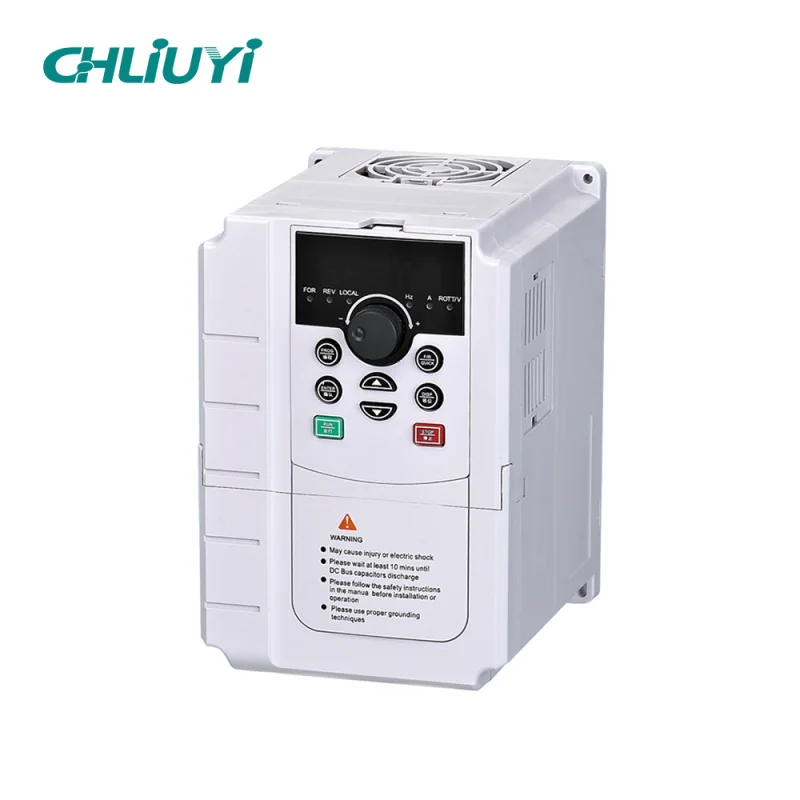
For applications that require continuous speed adjustment, Liuyi’s three-phase 380V VFD range includes PID control options in common industrial power ratings from 2.2 kW to 37 kW.
For an accurate quotation, provide the following information to your soft starter manufacturer or VFD supplier:
The soft starter vs VFD decision should not be based only on price.
Choose a soft starter when the motor runs at fixed speed and your priority is reducing startup current, mechanical shock, and control-panel cost.
Choose a VFD when the process needs variable speed, pressure control, flow regulation, energy optimization, or automation integration.
For OEMs, panel builders, electrical contractors, and industrial distributors, the most reliable approach is to define the motor load and operating profile before selecting the control device. A properly matched soft starter or VFD can improve equipment reliability, reduce unnecessary maintenance, and create a more stable electrical system.
Yes, a VFD can provide soft-start functionality because it controls motor acceleration. However, it may be unnecessary when the motor only needs smooth startup and always runs at full speed afterward.
A soft starter mainly reduces startup current and mechanical stress. It does not normally reduce energy consumption during full-speed operation because the motor still runs at rated speed.
Use a soft starter for a fixed-speed pump that only needs smoother startup. Use a VFD when pump pressure or flow must change based on demand.
No. A soft starter controls voltage during starting and sometimes stopping, but it does not provide continuous speed regulation.
In many applications, yes. A bypass contactor allows the motor to run directly from the supply after startup, reducing heat loss in the soft starter. Some soft starters include an internal bypass relay, but this should always be verified by model.
Select the VFD based on motor rated current, input voltage, load type, overload requirement, operating environment, and required control functions. Do not choose only by motor kW.
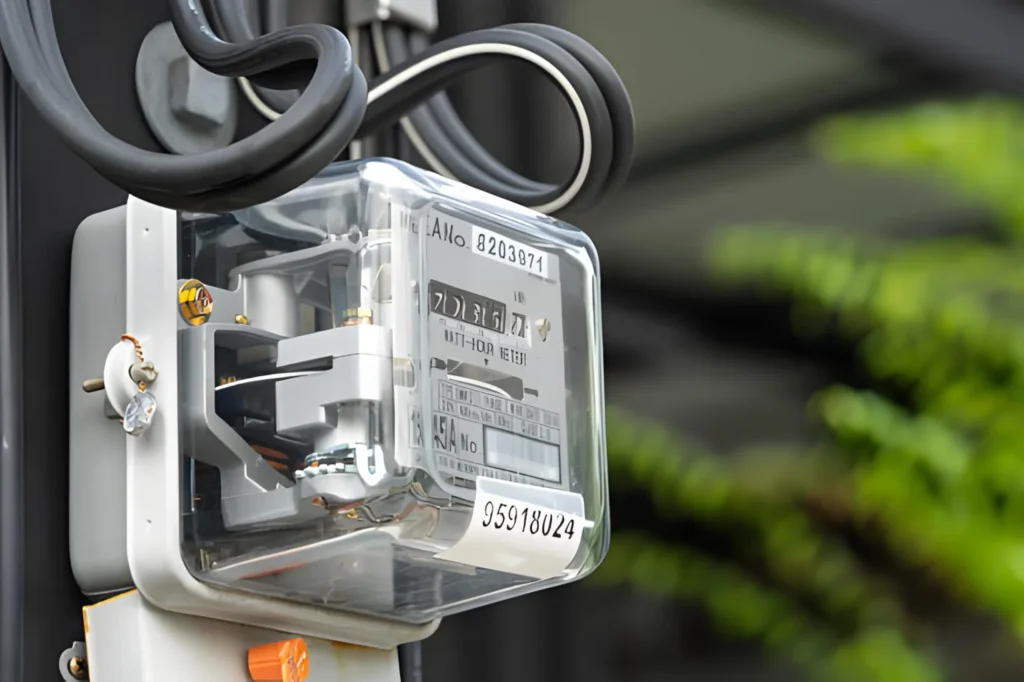
Discover Liuyi Electric’s precise electrical energy consumption meters with advanced accuracy, smart monitoring, and reliable industrial-grade performance.
Read More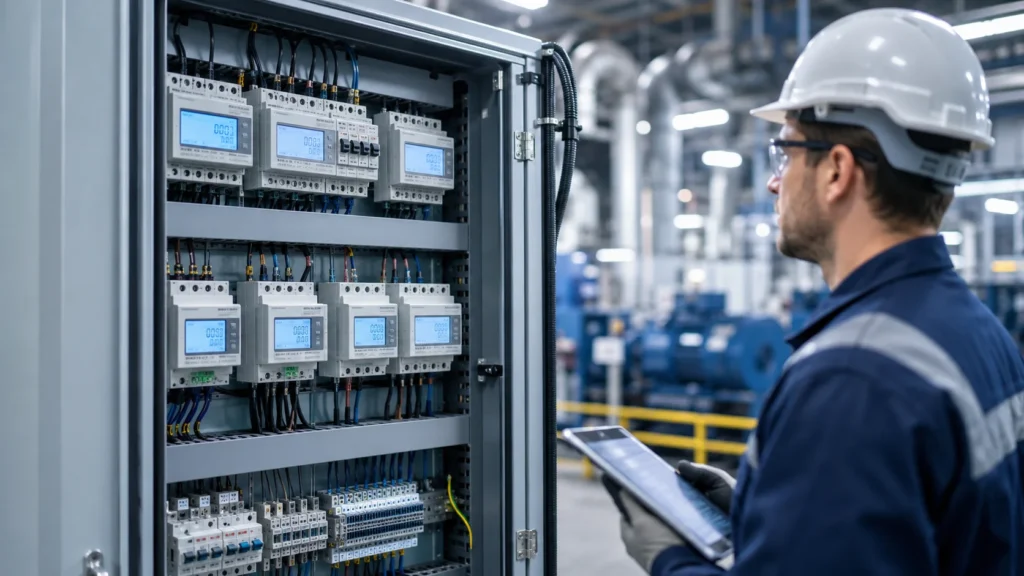
Industrial energy meters provide accurate measurement of power consumption in factories, commercial buildings, and industrial equipment. Explore smart and reliable energy monitoring solutions for industrial applications.
Read More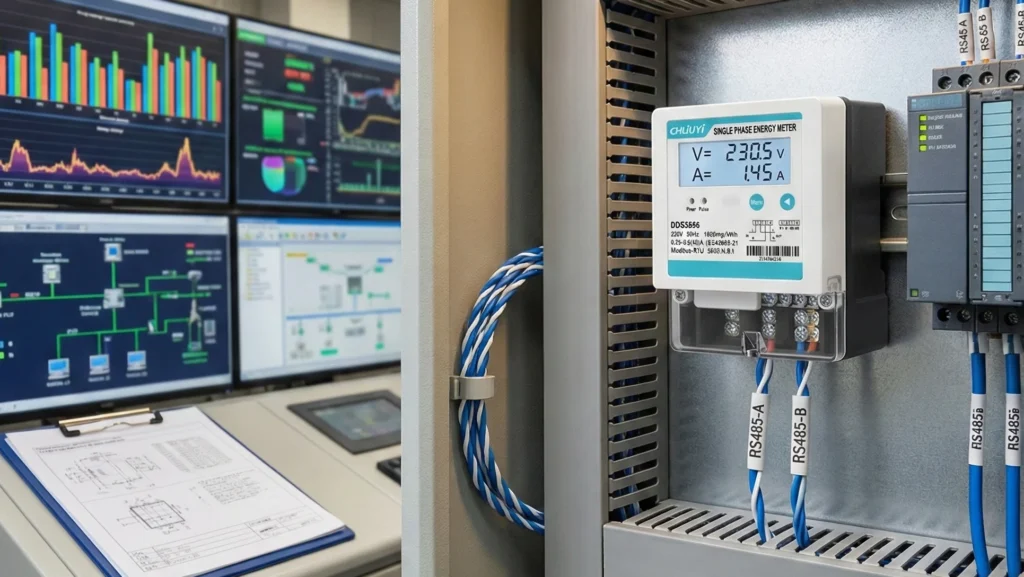
TABLE OF CONTENTS Industrial facilities seeking comprehensive energy monitoring capabilities increasingly rely on integrating RS485 Modbus energy meters into existing control infrastructure. These communication-enabled devices provide real-time power consumption data essential for energy management systems, predictive maintenance protocols, and operational efficiency optimization. Modern RS485 energy meters utilize the industry-standard Modbus RTU protocol over RS485 physical […]
Read More